

Our summer session registrations are now closed.
Please reach out for 1:1 Academic Intervention possibilities.
Summer Learning Sessions
Structured summer support for students who need help with writing, organization, assistive technology, executive functioning, academic skills, or school readiness.
Our sessions help students practise practical strategies in a supportive setting, so they can return to school feeling more prepared, independent, and confident.
Summer support can help students:
✓ Build writing, organization, study, and technology strategies.
✓ Practise skills without the same level of school-year pressure.
✓ Prepare for September with clearer routines and more confidence.
✓ Connect support to IEP or assessment recommendations when available.
Who Are These Programs For?
Our summer programs may be a good fit for students who avoid writing, struggle with organization, need support using assistive technology, have difficulty starting or completing schoolwork, or would benefit from a structured academic routine during the summer.
Students do not need a formal diagnosis to participate. If your child has an IEP, psychoeducational assessment, report card, or school recommendations, we can use that information to help guide support.
-

Writing
Planning, drafting, expanding ideas, revising, and building confidence with written work.
-

Organization
Systems for materials, assignments, digital files, deadlines, and school routines.
-

Technology
Text-to-speech, speech-to-text, typing, digital organization, and independent tool use.
-

Confidence
Helping students approach learning tasks with clearer strategies and less overwhelm.
Program Details
Summer programs are offered in small groups to provide structured support while allowing students to practise skills in a supportive learning environment. Families are asked to complete a Program Contact Form before placement is confirmed. Progress reports will be provided to families at the end of the program.
-

Cost
$400 per child, per program.
-

Group Size
Small groups of 3–4 students.
-

Daily Schedule
1–2 hours per day for 5 days.
-

Start Dates
Summer programs begin July 13, 2026. Ready for September begins August 20, 2026. Placement is confirmed after the Program Contact Form is reviewed.
-

Progress Reports
Progress reports will be provided to families at the end of the program.
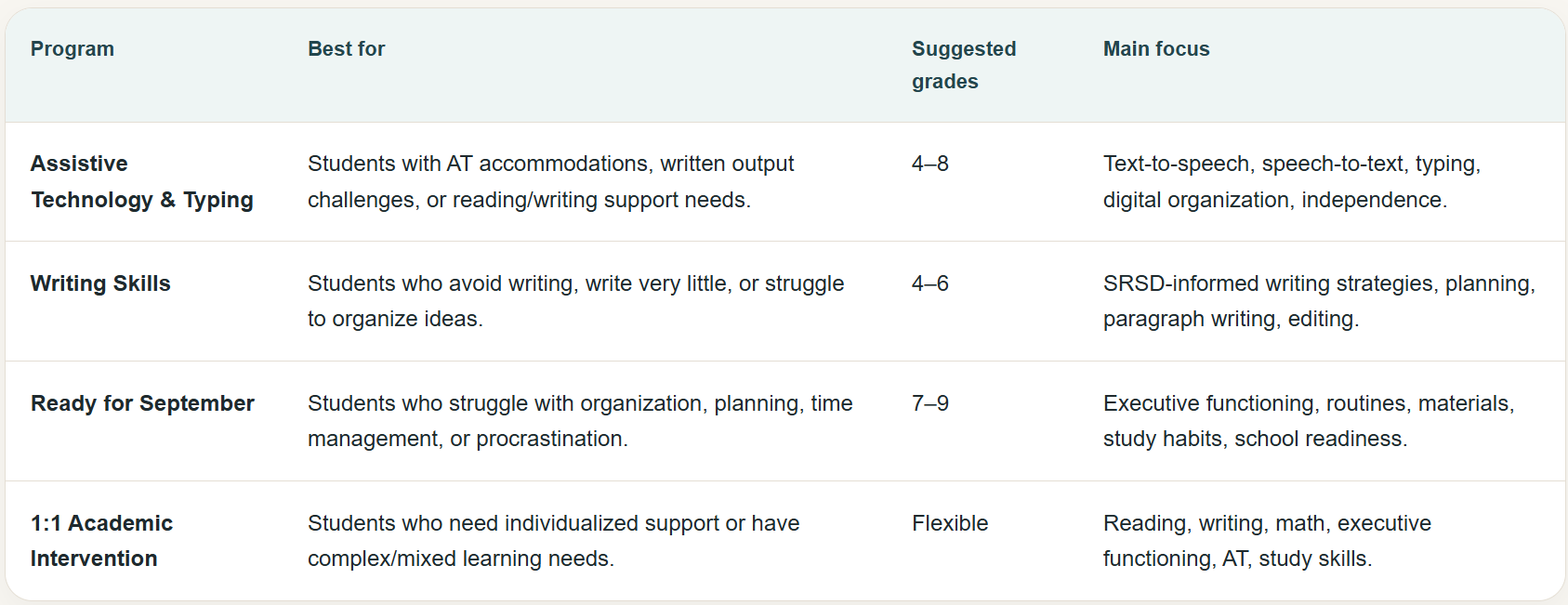
Program Comparison
Use this quick guide to identify the best starting point.
Assistive Technology & Typing
Recommended for students in Grades 4–8 · Small group · $400 per child · Begins July 13, 2026
This program helps students become more comfortable using technology to support reading, writing, editing, and schoolwork. Many students have assistive technology accommodations but do not yet feel confident using those tools independently.
The focus is not only on learning how to use different tools. Students are supported to understand which tools are helpful, when to use them, and how to use them more independently at school and at home.
This program may be helpful if your child:
Has assistive technology accommodations but rarely uses them
Has difficulty reading longer texts
Struggles to get ideas onto the page
Finds typing slow, tiring, or frustrating
Needs help with editing and proofreading
Has difficulty organizing digital files or assignments
Relies on adults to set up or troubleshoot technology
Students may practise:
Text-to-speech to support reading, comprehension, and editing
Speech-to-text/dictation for brainstorming and drafting
Word prediction and other writing-support tools
Typing fluency, accuracy, and confidence
Digital organization of files, worksheets, notes, and assignments
Troubleshooting common technology challenges
Explaining technology needs to teachers and parents
Program goal: Students develop a better understanding of which tools support their learning and how to use those tools with greater independence.
Writing Skills
Recommended for students in Grades 4–6 · Small group · $400 per child · Begins July 13, 2026
This program supports students who need help planning, organizing, and completing written work. Many students have strong ideas but struggle to get started, organize their thoughts, write enough detail, or revise their work independently.
Our writing sessions are guided by principles from Self-Regulated Strategy Development, also known as SRSD. SRSD-informed instruction helps students learn writing strategies while also building planning, self-monitoring, goal-setting, and independence.
This program may be helpful if your child:
Avoids writing tasks
Says they do not know what to write
Has good ideas verbally but struggles to write them down
Writes very little or gives short answers
Has difficulty organizing ideas into paragraphs
Struggles to add details, examples, or explanations
Rushes through writing without checking their work
Students may practise:
Understanding the purpose of a writing task
Brainstorming ideas before writing
Organizing ideas using planning tools or graphic organizers
Writing stronger sentences and paragraphs
Adding details, examples, and explanations
Using checklists to monitor their work
Setting small writing goals
Revising and editing with support
Program goal: Students develop a better understanding of which tools support their learning and how to use those tools with greater independence.
Ready for September
Recommended for students in Grades 7–9 · Small group · $400 per child · Begins August 20, 2026
The return to school can be challenging for students who struggle with organization, time management, planning, or independent work habits. This program helps students practise the executive functioning skills they need to manage school demands more effectively.
The focus is on helping students build practical systems before the school year begins, rather than waiting until they feel overwhelmed.
This program may be helpful if your child:
Forgets assignments or due dates
Has difficulty starting tasks independently
Leaves work until the last minute
Loses materials or has disorganized binders, folders, or digital files
Struggles to break assignments into smaller steps
Has difficulty estimating how long work will take
Needs frequent reminders from parents or teachers
Students may practise:
Organizing binders, folders, digital files, and school materials
Using calendars, planners, or digital tools
Tracking assignments and due dates
Breaking assignments into smaller steps
Estimating how long tasks may take
Creating realistic homework and study routines
Preparing for tests, projects, and longer assignments
Building independence with school routines
Program goal: Students develop a better understanding of which tools support their learning and how to use those tools with greater independence.
1:1 Academic Intervention
Available for elementary, middle, and high school students · 1:1 format and scheduling based on student needs
Some students benefit most from individualized support that is tailored to their specific learning profile, academic goals, or school recommendations. One-to-one academic intervention allows us to focus directly on the student’s current needs, pace, and learning style.
Sessions may target reading, writing, spelling, math, executive functioning, assistive technology, study skills, or preparation for the upcoming school year. Support can also be aligned with recommendations from an IEP, psychoeducational assessment, report card, or school team.
This program may be helpful if your child:
Needs support in a specific academic area
Has mixed learning needs that do not fit one group program
Requires individualized pacing
Has recommendations from a psychoeducational assessment or IEP
Needs help rebuilding confidence after a difficult school year
Would benefit from targeted support before September
Students may practise:
Reading fluency and comprehension
Written expression and paragraph structure
Spelling and vocabulary development
Math foundations or problem-solving
Study strategies and test preparation
Executive functioning and organization
Assistive technology use
Academic confidence and independence
Program goal: Students develop a better understanding of which tools support their learning and how to use those tools with greater independence.
Summer Program Contact Form
Frequently Asked Questions
-
No. Students do not need a formal diagnosis. Many students join because they need support with writing, organization, confidence, technology, or school readiness.
-
Yes. If your child has an IEP, psychoeducational assessment, report card, or school recommendations, we can use that information to help guide support.
-
No. The Program Intake Forms are not assessments. They are short screening forms that help us understand your child’s needs and determine whether the program is likely to be a good fit.
-
Our summer sessions are more targeted than general tutoring. While academic skills are supported, the focus is also on strategy use, independence, confidence, and helping students understand how to approach learning tasks more effectively.
-
Yes. Some students may benefit from a group program combined with individualized academic intervention. The Program Screening Form helps us determine whether this may be appropriate.
-
Yes. Progress reports will be provided to families at the end of the program, summarizing the skills practised and recommendations for continued support.
-
Our team reviews the information and follows up regarding the most appropriate next step. This may include confirming fit, asking for additional information, or recommending one-to-one support.
Help your child return to school feeling prepared.
Choose the program that best matches your child’s needs and complete the short Program Contact Form today.